
Green goal for clean and plentiful water still off track, OEP finds
(by Karma Loveday)
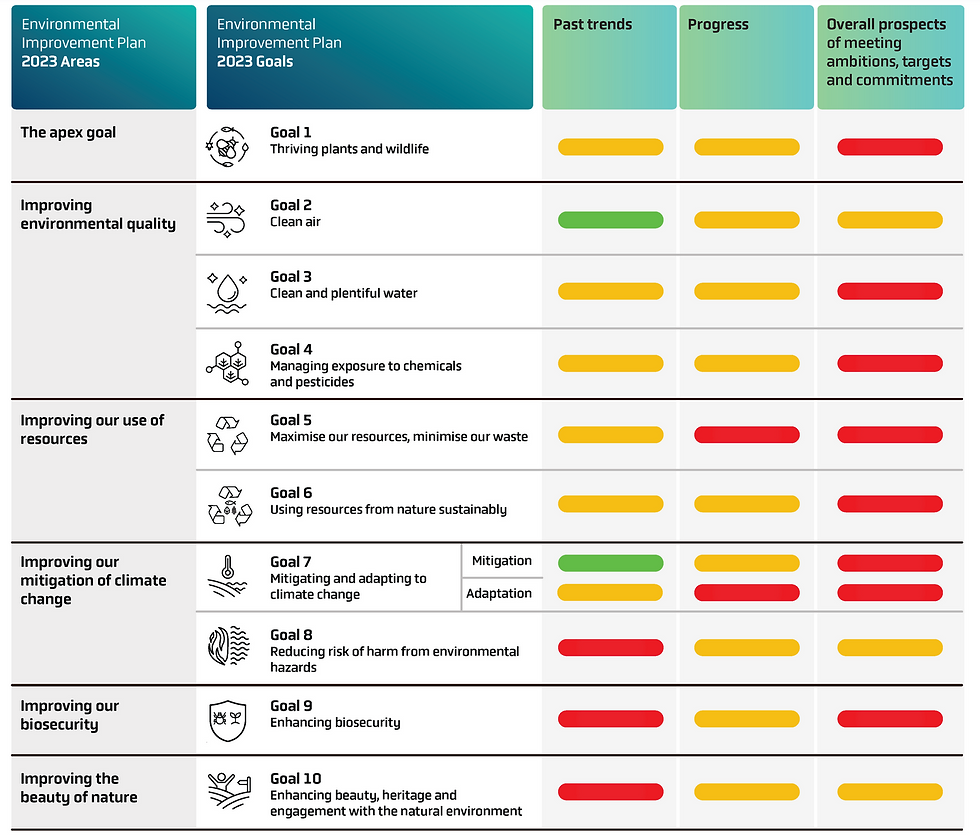
In the year to the end of March 2025, the Environmental Improvement Plan’s (EIP) third goal – for clean and plentiful water – remained largely off track.
That was among the conclusions of the Office for Environmental Protection’s (OEP) fourth statutory report on the Government’s progress in delivering its EIP. Progress towards the water goal in the year, and past water trends, were mixed.
The water story echoed that of the wider environmental picture (see table). The OEP found the Government to still be off track to meet its environmental commitments, although it is worthy of note that this reporting cycle stopped too soon to take in December 2025’s revised EIP, which the OEP was positive about in its initial view.
In the year to March 2025, the OEP found good progress had been made towards 12 of the 43 individual targets and commitments, mixed progress made towards 19, and limited progress towards 12. Of the 13 of the 43 that are formally Environment Act 2021 (EA21) targets, good progress was made towards four (including reducing phosphorus loadings from treated wastewater), mixed progress towards seven and limited progress towards two. The watchdog noted that a higher proportion of targets and commitments showed good progress and a lower proportion showed limited progress compared to the 2023/2024 progress report.
In terms of overall prospects of meeting the 43 targets, the Government was on track towards five, partially on track towards 16, and largely off track towards 21 (one target could not be assessed due to a lack of sufficient evidence). For the 13 EA21 targets, the Government was largely on track for meeting three, partially on track for five and largely off track for five. Compared to the 2023/2024 progress report, a slightly lower proportion of targets were considered largely on track and a slightly higher proportion largely off track.
OEP chair Dame Glenys Stacey said: “We have previously called for Government to speed up and scale up its efforts if it is to achieve its environmental ambitions and commitments, and we renew that call now. While we have seen more progress in this year than in the previous reporting period, it was not the step change needed.
“Government remains largely off track to meet its environmental targets and obligations, including legally binding biodiversity targets set under the Environment Act and the UK’s twin 30 by 30 commitments both for protected areas and for restoring degraded ecosystems. The government must now decide whether or not it is going to meet those targets. What happens now matters.”
Dame Glenys also observed: “Alongside the new EIP, government continues to work on a long-awaited Land Use Framework, a new Farming Roadmap, Food Strategy, Circular Economy Strategy and a UK Marine Strategy, all alongside significant planning and water sector reform. There is now a real opportunity for all of these reforms to complement the revised EIP, to provide coherence from the strategic policy level through to local decision making. As we have long said, the most important thing now is effective delivery of the plan.”
The OEP’s eight key recommendations from 2023/24 remained unchanged. These were to:
Get nature-friendly farming right.
Maximise the contribution of protected sites for nature.
Speed up action in the marine environment.
Set out clear mechanisms for reconciling competing demands for land and sea.
Develop a circular economy framework.
There were also three cross-cutting recommendations, to: mobilise investment at the scale needed, regulate more effectively and harness the support needed.
Comments